
Ozark, MO · Garage Door Service
Garage Door Spring Repair Around Ozark
Broken torsion or extension spring on your Ozark home? We explain what causes spring failure in this area's housing stock and climate, and what the repair involves.
- Repairs & new doors
- Springs & openers
- Serving 6 nearby communities
The Cost of This Job
We're not going to throw a number at you here, because spring jobs vary more than people expect. A single torsion spring on a standard double door costs less than a matched pair on a heavier insulated door, and the price shifts again if the drums, bearings, or cables show wear once we're up on the ladder looking at it. What we can tell you is how to think about it: a spring replacement is a parts-and-labor job, not a diagnostic fee plus a guess. If a second spring is close to failing, we'll say so before we close the door, because coming back out in three months for the other side costs you a second trip you didn't need to pay for. With median household income in the service area at $60,670, most owners we talk to want the straight repair cost up front, not a sales pitch toward a full opener swap. If replacement beats repair - say the shaft is bent or the drums are rusted through - we'll tell you that too, honestly, before any work starts.
What You Are Seeing
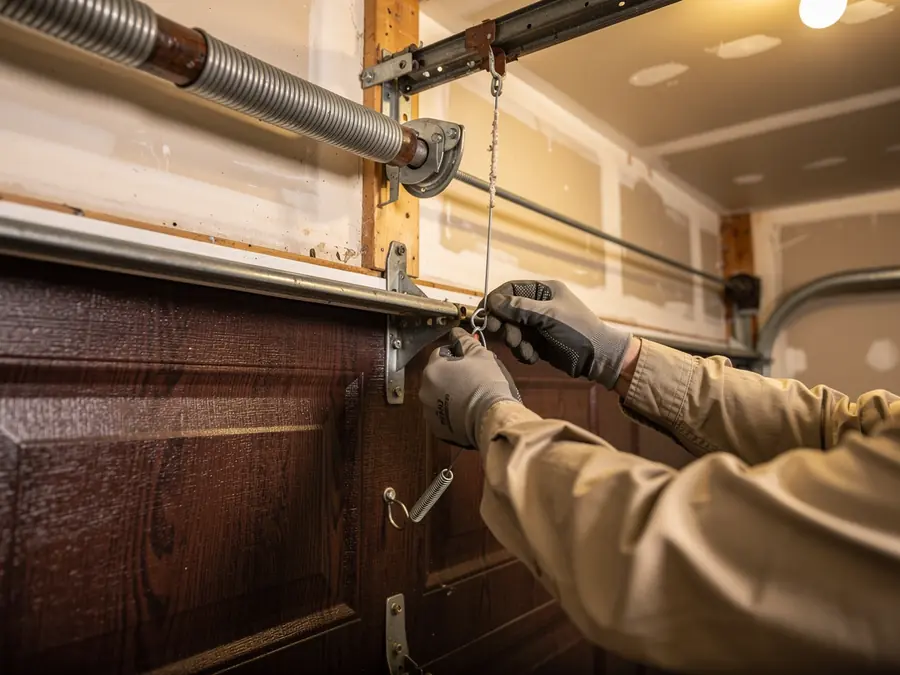
The classic sign is a door that won't budge, or one that slams down fast instead of lowering smooth. If you've got torsion springs mounted on a shaft above the door, a snapped one usually shows as a visible gap in the coil - sometimes you'll hear the bang when it lets go. Extension springs, the kind running along the horizontal tracks on either side, tend to stretch and sag before they snap, so you might notice the door sitting crooked or one side dragging before full failure. Either way, don't pull the emergency release and try to lift it by hand. A door on a bad spring is heavier than it looks, and the opener will keep straining against dead weight until something else gives - usually the gear set inside it. If the opener is making noise but the door isn't moving, that's often the spring, not the motor. We see both spring types across the area's housing stock, and the fix differs enough between them that it's worth having a tech look before you order parts yourself.
What Causes It Around Here
Most of the housing in this service area went up between 1956 and 2010, with the bulk of it dating to the 1980s and 90s across the eleven named areas we cover. That matters for springs because a spring is rated for a cycle count - open and close roughly ten thousand times - not a calendar date, and a lot of those 80s and 90s doors are still running their original torsion hardware decades past that rating. Add in a cold moderate climate: steel contracts in winter, and a spring already near the end of its cycle life is more likely to let go on a January morning than a mild afternoon. Humidity swings through the seasons also work on the coil over time, especially on springs that were never upgraded from builder-grade to a heavier gauge. We're not going to tell you every older door around here is about to fail - plenty aren't - but if your house falls in that 1980s-90s band and the spring's never been replaced, it's closer to end-of-life than most owners assume.
How Long It Takes
A straightforward spring swap - one or two torsion springs, no cable or drum damage - is usually a same-visit job once a tech is on site with the right spring size. What stretches it out is anything we find once the door's open: a worn bottom bracket, a cable that's frayed from running against a bad drum, or a track that's slightly bent from the door dropping unevenly before it was caught. None of that is common, but it's common enough that we check before buttoning the door back up, rather than handing it back and hoping. One limitation worth being upfront about: if you need a spring size that's unusual for your door's weight or width, that part isn't always on the truck, and we may need to order it. We'd rather tell you that than install the wrong spring to finish the job fast.
Frequently asked questions
Can I replace a garage door spring myself?
We don't recommend it. A torsion spring is under enough tension to cause serious injury if it releases wrong, and the winding bars and cone setup take practice to use safely. Extension springs are a bit more forgiving but still store real force. This is one of the few garage door jobs where the risk-to-savings ratio doesn't favor doing it yourself.
Why did my spring break in cold weather?
Steel gets less flexible as temperatures drop, and in our cold moderate climate a spring that's already near the end of its rated cycle count is more likely to snap on a cold morning than a mild one. It's rarely the cold alone - it's age plus cold.
Is it normal for only one spring to break on a two-spring door?
Yes, but we usually recommend replacing both if they're the same age, since the second one is likely close behind. Mismatched spring age is one of the more common reasons people end up calling twice instead of once.
Do older Ozark-area homes need a different spring than newer ones?
Not usually a different type, but often a different size or gauge, especially on houses built before insulated doors became standard. A lot of the area's housing dates to the 1980s and 90s, and some of those doors still carry original builder-grade springs sized for a lighter door than what's on them now.
Related services
By Neighborhood
Spring Repair across the Ozark area
We also handle spring repair in these Ozark-area suburbs.
Book garage door service in Ozark
Call now or request a quote - tell us what the door is doing and where you are.