
Ozark, MO · Garage Door Service
Garage Door Service for Battlefield Homes
Newer-build garage doors in Battlefield need different parts than the older stock elsewhere in the service area. Here's what a truck from Ozark brings for the 10-mile call.
- Repairs & new doors
- Springs & openers
- Serving 6 nearby communities
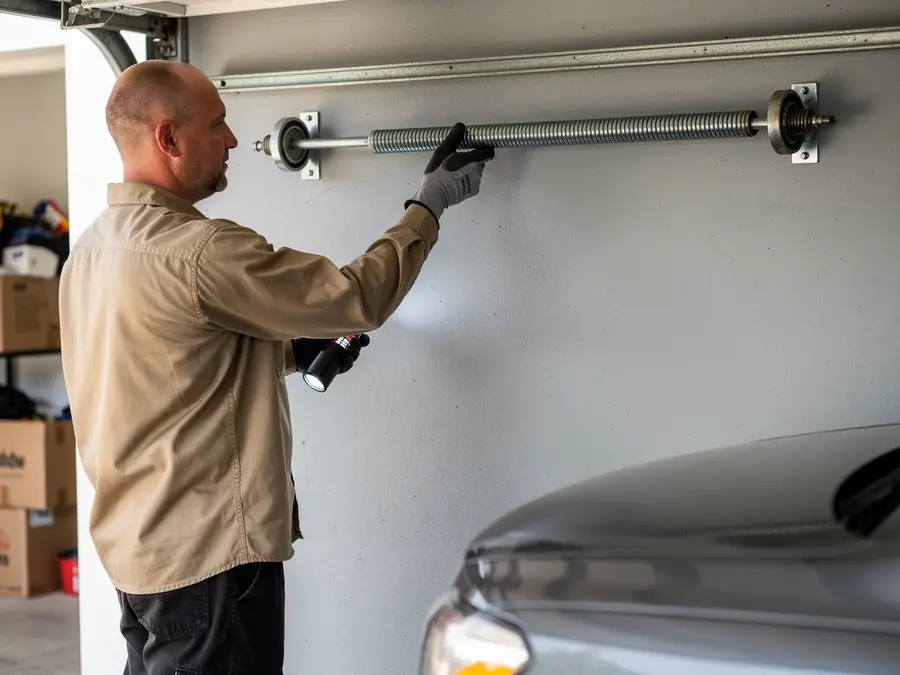
What Is on the Truck
Battlefield sits ten miles out from Ozark, which is close enough that a truck can carry parts for this neighborhood specifically rather than guessing. That matters because Battlefield's housing stock skews newer than a lot of the wider service area - the median build year here is right around 2000, where across the full territory the range runs 1956 to 2010 with a median closer to 1995. A door built in 2000 is almost always a factory steel sectional on a torsion spring sized to a known weight, not the older extension-spring setups or odd one-off panel doors that turn up in older pockets. So the truck headed to Battlefield is loaded for mid-size torsion springs, standard 2-inch track, and openers with circuit boards rather than purely mechanical gear-and-sprocket units. It's a more predictable call than some of the older towns in the area, which keeps the drive worth making for a single-door job.
What the Repair Takes
Because the ten-mile drive from Ozark is built into how the call is scheduled, the work itself tends to move fast once the truck is on-site - there's less time lost chasing down an odd part on a 1970s door that nobody stocks anymore. A snapped torsion spring on a 2000-era door is a known quantity: standard wire gauge, standard drum, bolts that haven't rusted solid yet because the house isn't old enough for that. Openers from this era are usually chain or belt drive with a circuit board that either works or doesn't - testing it is quick. The honest limit here: if a part on a newer opener has failed inside the control board itself rather than the motor or gears, that's sometimes a replace-the-unit call rather than a repair, since board-level parts for mid-2000s openers aren't something every truck carries.
What Causes It Around Here
The service area sits in a cold-moderate climate band, and that shows up the same way in Battlefield as anywhere else in the territory - temperature swings stiffen lubricant, shrink weatherstrip, and put extra load on springs during the first cold mornings of the season. What's different in Battlefield is the age of the hardware taking that load. A spring installed when a house was built in 2000 has had roughly two decades of cycles, which is close to the point where fatigue failure becomes common even without a dramatic event. Combine that with Battlefield's household income running meaningfully higher than the area median, and it's a town where owners more often catch a stiff door and call before it snaps, rather than running it to failure. That changes the mix of calls toward tune-ups and early spring swaps rather than emergency lockouts.
The DIY Question
On a door this age, a homeowner can safely handle the small stuff - lubricating rollers and hinges, tightening the lag bolts that back out over time, swapping a remote battery. What doesn't belong on a Saturday project list is anything touching the torsion spring itself. These springs hold real tension even on a standard-weight door, and a 2000-era setup doesn't make that any safer to unwind by hand. If the opener's circuit board is throwing an error code, that's also not a diagnose-it-yourself situation - guessing wrong on an opener board can mean replacing a part that didn't need replacing. The honest line: lubrication and visual checks, yes; springs, cables, and anything inside the opener housing, no.
What You Are Seeing
If a door in Battlefield is sagging unevenly on one side, that's usually a cable or one of the two torsion springs that's gone slack rather than both at once - doors from this era are built symmetrically enough that uneven sag points to one side failing first. A door that reverses right after touching the floor is often a sensor alignment issue, common on openers from the 2000s with photo-eye safety sensors low on the track. Grinding or popping during travel points to a roller or bearing wearing out, which on a door this age is about on schedule. None of this is an emergency pattern unique to Battlefield, but it is the pattern that shows up most on houses built around the turn of the millennium.
Frequently asked questions
Why does a company based in Ozark cover Battlefield?
Battlefield is about ten miles from Ozark, close enough that the truck carries parts suited to this neighborhood's housing stock specifically. It isn't a separate branch or depot - it's a service call that starts from Ozark and runs the distance for the job.
Are Battlefield garage doors different from older parts of the service area?
Generally newer. Battlefield's median build year is around 2000, while the wider service area ranges from 1956 to 2010. That means more standard factory torsion springs and circuit-board openers, and fewer of the older mechanical setups found in older pockets of the territory.
Do cold winters affect doors in Battlefield?
Yes - the whole service area sits in a cold-moderate climate band, and temperature swings stiffen lubricant and strain springs every season. On a Battlefield door, that stress lands on hardware that's now old enough, in many cases, to be nearing normal spring fatigue.
Should I fix or replace an opener with a board issue?
It depends on the failure. A motor or gear problem is usually a repair. A failure inside the control board itself on an opener from the early 2000s sometimes isn't worth sourcing parts for, and replacing the unit ends up being the more practical call.
More garage door services in Battlefield
Book garage door service in Ozark
Call now or request a quote - tell us what the door is doing and where you are.